

How To Clean The Filter Of Exhaust System Pictures 2008 Ford Super Duty F350 6.0diesel
For most people, a motorcar is a affair they fill up with gas that moves them from point A to point B. But have you ever stopped and thought, How does it really do that? What makes it movement? Unless you have already adopted an electrical machine as your daily driver, the magic of how comes down to the internal-combustion engine—that thing making noise nether the hood. But how does an engine work, exactly?
Specifically, an internal-combustion engine is a heat engine in that it converts energy from the heat of burning gasoline into mechanical work, or torque. That torque is applied to the wheels to make the motorcar motion. And unless you are driving an ancient two-stroke Saab (which sounds like an one-time concatenation saw and belches oily smoke out its exhaust), your engine works on the same basic principles whether you're wheeling a Ford or a Ferrari.
Engines have pistons that move up and down within metal tubes called cylinders. Imagine riding a bicycle: Your legs motility upward and downwards to plough the pedals. Pistons are continued via rods (they're like your shins) to a crankshaft, and they movement up and downward to spin the engine'southward crankshaft, the same style your legs spin the bicycle's—which in turn powers the bike'south drive bike or car's bulldoze wheels. Depending on the vehicle, there are typically between two and 12 cylinders in its engine, with a piston moving upwardly and down in each.
Where Engine Power Comes From
What powers those pistons up and downwardly are thousands of tiny controlled explosions occurring each infinitesimal, created by mixing fuel with oxygen and igniting the mixture. Each time the fuel ignites is called the combustion, or ability, stroke. The rut and expanding gases from this miniexplosion push the piston downward in the cylinder.
Almost all of today'south internal-combustion engines (to keep information technology simple, nosotros'll focus on gasoline powerplants here) are of the four-stroke variety. Beyond the combustion stroke, which pushes the piston down from the meridian of the cylinder, there are three other strokes: intake, compression, and frazzle.
Engines need air (namely oxygen) to burn fuel. During the intake stroke, valves open to allow the piston to act similar a syringe as it moves downward, drawing in ambient air through the engine'southward intake system. When the piston reaches the bottom of its stroke, the intake valves shut, effectively sealing the cylinder for the compression stroke, which is in the opposite direction as the intake stroke. The upward movement of the piston compresses the intake charge.
The Iv Strokes of a Four-Stroke Engine

In today's about modernistic engines, gasoline is injected directly into the cylinders near the top of the pinch stroke. (Other engines premix the air and fuel during the intake stroke.) In either case, just before the piston reaches the top of its travel, known every bit meridian dead center, spark plugs ignite the air and fuel mixture.
The resulting expansion of hot, burning gases pushes the piston in the opposite direction (down) during the combustion stroke. This is the stroke that gets the wheels on your machine rolling, simply like when y'all push downwards on the pedals of a bike. When the combustion stroke reaches bottom dead center, frazzle valves open to allow the combustion gases to get pumped out of the engine (like a syringe expelling air) as the piston comes up again. When the frazzle is expelled—it continues through the car's exhaust system before exiting the back of the vehicle—the frazzle valves close at top dead eye, and the whole process starts over once again.
This content is imported from {embed-proper name}. Yous may be able to find the same content in another format, or you may be able to detect more than data, at their web site.
In a multicylinder car engine, the private cylinders' cycles are beginning from each other and evenly spaced and then that the combustion strokes do not occur simultaneously and so that the engine is as balanced and smooth as possible.
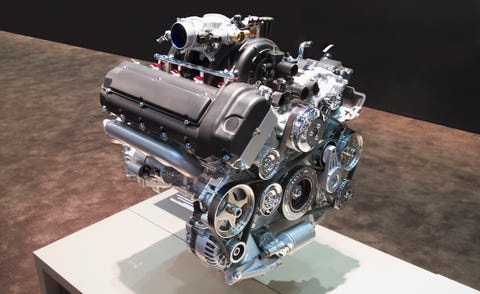
But non all engines are created equal. They come in many shapes and sizes. Near motorcar engines arrange their cylinders in a straight line, such as an inline-iv, or combine two banks of inline cylinders in a vee, as in a V-half-dozen or a V-8. Engines are besides classified by their size, or displacement, which is the combined book of an engine's cylinders.
The Different Types of Engines
In that location are of form exceptions and minute differences amongst the internal-combustion engines on the market. Atkinson-bicycle engines, for example, change the valve timing to brand a more efficient but less powerful engine. Turbocharging and supercharging, grouped together under the forced-induction options, pump additional air into the engine, which increases the bachelor oxygen and thus the corporeality of fuel that can be burned—resulting in more ability when you lot want it and more efficiency when you don't demand the power. Diesel engines practise all this without spark plugs. But no matter the engine, as long as information technology's of the internal-combustion diversity, the basics of how it works remain the same. And at present you know them.
Fourth dimension to Give Your Ride a Spring Cleaning? Attempt the Meguiar'south Products We Use on Our Fleet


This content is created and maintained by a third party, and imported onto this page to help users provide their email addresses. You may be able to find more information most this and similar content at piano.io

Source: https://www.caranddriver.com/features/a26962316/how-a-car-works/
Posted by: milneribrat1997.blogspot.com
0 Response to "How To Clean The Filter Of Exhaust System Pictures 2008 Ford Super Duty F350 6.0diesel"
Post a Comment